
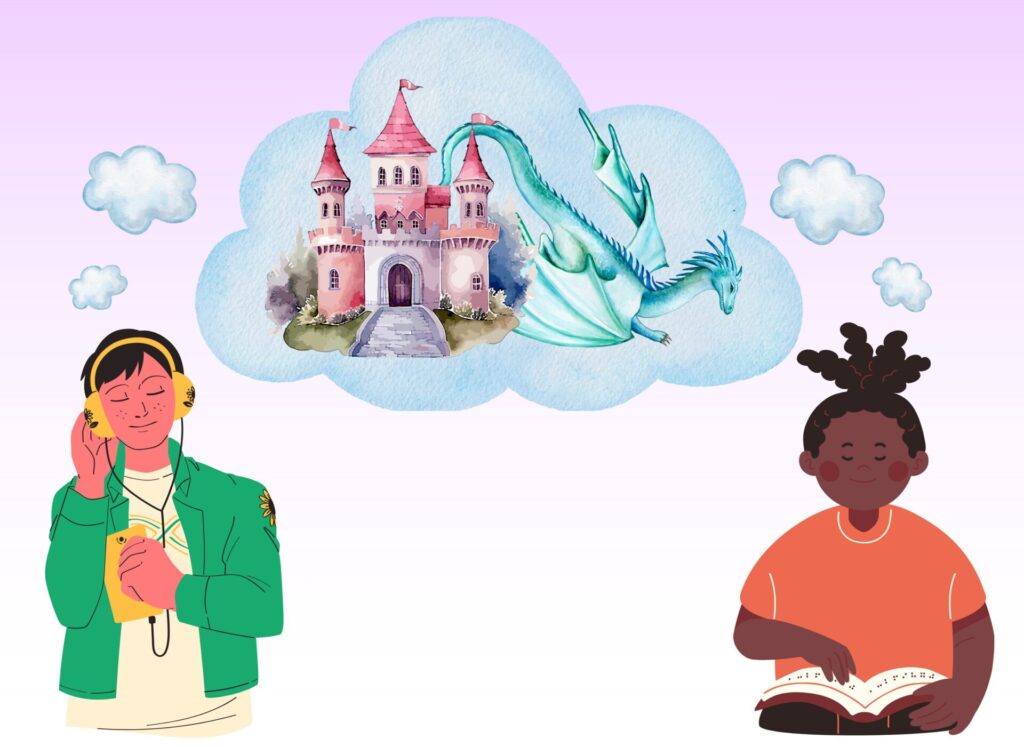
When people ask how blind people read, the answer they expect is usually: audiobooks. It’s the format that most sighted people have heard of, and in some ways, it has become shorthand for accessible reading as a whole. But it is only one part of a much wider picture. In the UK, blind and partially sighted people access books, news, and stories in a remarkable variety of ways; shaped by personal preference, the degree of their sight loss, how long they’ve been reading without full vision, and simply what works best for them. There is no single answer to how blind people read, and that’s precisely the point. Here are seven real ways people read.
1. Braille: reading through touch
Braille is often the first thing people think of when they ask how blind people read, and it remains one of the most important forms of literacy for people with little or no vision. Developed in France by Louis Braille in the early 19th century, Braille uses raised dot patterns to represent letters, numbers, and punctuation. It is read with the fingertips, and for people who learn it well, it can be fast, precise, and deeply private. You can read a braille book on a bus, or follow a script on stage, without relying on any technology at all. In the UK, the RNIB Library holds more than 11,000 braille books across a wide range of genres, all available free of charge. Modern braille also extends into music notation, mathematics, and science—it isn’t limited to prose. It’s worth knowing that most blind people in the UK are not braille readers. Braille literacy is highest among people who have been blind since childhood or early life. Those who lose their sight later, which is the majority of people with sight loss in the UK, often find it harder to learn as adults, though many do. The RNIB offers braille learning support for people at any stage of their sight loss journey.
2. Talking books and the RNIB Talking Books service
Talking books have been central to accessible reading in the UK for nearly a century. RNIB’s Talking Books Library was founded in 1935, originally to provide books to soldiers blinded during the First World War, and it remains one of the most-used services in the country. Today, the service gives access to over 40,000 titles in accessible audio format, covering fiction, non-fiction, biography, and much more. It is entirely free for blind and partially sighted people to join and use. The recordings are professional productions (narrated by actors and voice artists), which means they’re very different in quality from a text-to-speech system. Many readers describe the experience of a well-narrated talking book as closer to being read to than to listening to a computer voice. The library also includes braille books and giant print titles. You can access talking books by downloading directly, receiving a USB stick by post, or, in some cases, via a DAISY disc.
3. DAISY: structured audio that works like a real book
DAISY stands for Digital Accessible Information System, and it solves a problem that anyone who has listened to a long audiobook will recognise: how do you navigate back to a specific chapter, or jump to a particular section, without scrubbing through hours of audio? DAISY format allows readers to move through an audiobook by chapter, section, paragraph, or page number—the same way a sighted reader might flip through a physical book. It’s a significantly more flexible and functional reading experience than a standard MP3 audiobook, and it’s widely used in the UK through RNIB and other services. For longer non-fiction, textbooks, or reference material, the DAISY format makes a real practical difference. It’s particularly valued by students and professionals who need to return to specific passages.
4. Large print books
Not all people with sight loss are unable to read visually. Many blind and partially sighted people have some remaining useful vision, and for them, large print books can be a simple, low-tech way to continue reading in a familiar format. Large print is typically set at 16–18pt or above, with wider spacing and high-contrast print. For people with conditions like macular degeneration or glaucoma, where some central or peripheral vision remains, this can be enough to read comfortably. The RNIB Library includes large print titles, and many local libraries in the UK stock large print collections as part of their standard lending service. It’s worth asking; access varies by borough and county, but most public libraries can arrange large print loans even if the titles aren’t physically on the shelf.
5. Tactile and multi-sensory books
For people who enjoy reading visually but have significant sight loss, tactile books offer something different: stories and information you can feel as well as hear. Living Paintings is a UK-based charity that creates tactile books combining raised images, colour print, and audio guides. Each book includes a description that helps the reader explore the tactile images, so the experience isn’t just about the text, but about the visual world the book is describing. Their library is free to join and can be accessed by post. The ClearVision Project takes a slightly different approach: a postal lending library of children’s books that combine print and braille, designed to be shared between sighted and blind readers. A blind parent and their sighted child, or a partially sighted child and their class, can read the same book together, which matters as much as the reading itself.
6. Screen readers and digital text
Many blind and partially sighted people read through screen readers — software that converts digital text into synthesised speech (or, for braille display users, into braille output). On Apple devices, VoiceOver is built in. On Android, TalkBack performs a similar function. On computers, software like JAWS or NVDA is widely used. These tools can read anything that exists as digital text: ebooks, websites, documents, emails, and newspapers. In practice, screen readers work best when the digital content they’re reading has been designed with accessibility in mind. A well-formatted ebook or webpage reads smoothly; a poorly formatted one, or content embedded in an image, can be difficult or impossible to navigate. This is why accessible design matters far beyond assistive technology itself. For reading books specifically, apps like Apple Books, Kindle, and Google Play Books all support text-to-speech. Audible and the RNIB’s own digital library can also be accessed via a screen reader on a phone or tablet. BBC Sounds has a growing audiobook collection that is free and accessible through the app.
7. Voice-first technology and community reading
The most recent development in accessible reading isn’t just about the format of the book; it’s about how reading fits into a daily routine, and whether it connects people to others. Voice-first devices (phones and tools that are operated entirely by voice, without needing to navigate a visual interface) allow readers to stream audiobooks, newspapers, and magazines by simply asking for them. There’s no app to find, no screen to navigate, no settings to adjust. You ask for what you want, and it plays. Beyond access to the text itself, services like RealSAM BookClub bring a social dimension to reading that had often been missing from accessible formats. Members choose a monthly book together, discuss it in a live online session, and share recommendations — the same kind of reading community that sighted readers have always been able to join through a local book group, but built around the formats and tools that work for blind and partially sighted people. Reading has always been a social act as well as a private one. Voice-first technology is one of the ways that’s becoming more possible for everyone.
How do blind people read? In whatever way works for them
The most important thing accessible reading has learned over the past century is that there is no single right answer. Braille is not better than audiobooks. Talking books are not better than large print. Screen readers are not better than tactile books. What matters is that each person can read in the way that suits their vision, their history with reading, and their daily life. In the UK, the infrastructure to support that choice is genuinely strong: RNIB, Calibre Audio, Listening Books, Living Paintings, ClearVision, BBC Sounds, and local library services all play a role. The challenge is often not whether a service exists, but whether people know it’s there and can access it easily. If you’re newly navigating sight loss, either for yourself or someone you care about, the RNIB’s helpline (0303 123 9999) is a good place to start.
RealSAM BookClub is a free reading community for blind and partially sighted people, offering a monthly book pick, live discussions, and accessible audio through voice-first technology. Find out more about RealSAM BookClub →