
Accessible reading has a long history. Here’s some of it.
People who can’t access print have been finding ways to read for far longer than technology would suggest. Here’s a short history of accessible reading.
Before smartphones. Before MP3 players. Before cassette tapes. Long before any of the formats we now associate with accessible reading existed, individuals and organisations were asking the same question: how do we make the experience of books and literacy available to people who cannot access print?
The answers they found were ingenious, practical, and built to last. A lot of what they created is still in use today.
This article traces that history, from the invention of Braille to the services available today, and explains where RealSAM BookClub sits in that ongoing tradition.
1824: Louis Braille and the invention of tactile reading
The generally agreed-upon starting point in the history of accessible reading is Louis Braille. Born in Coupvray, France, in 1809, Braille lost his sight at the age of three, following an accident in his father’s workshop. He went on to study at the Royal Institute for Blind Youth in Paris, where he encountered a system of raised dots originally developed for military communication at night.
Braille adapted and refined that system into what became the Braille alphabet; a tactile code in which each character is represented by a pattern of up to six raised dots that can be read by running fingertips across a page. He completed the first published version in 1824, when he was fifteen years old. The full system, including musical notation, was published in 1829.
Braille gave blind people a route to literacy that didn’t depend on sighted assistance and didn’t require them to read an approximation of a visual format. It was designed for the fingertip, not adapted from something designed for the eye. That distinction—that something be created for, not adapted for—still matters when thinking about accessible technology today.
The Braille system remains largely the same today and is still used globally. In the UK, organisations (including RNIB) continue to produce Braille books, magazines, and educational materials. The DAISY Consortium is currently working to make music Braille scores more widely available for blind musicians worldwide, demonstrating that the system Braille developed is still being extended nearly two centuries after its invention.
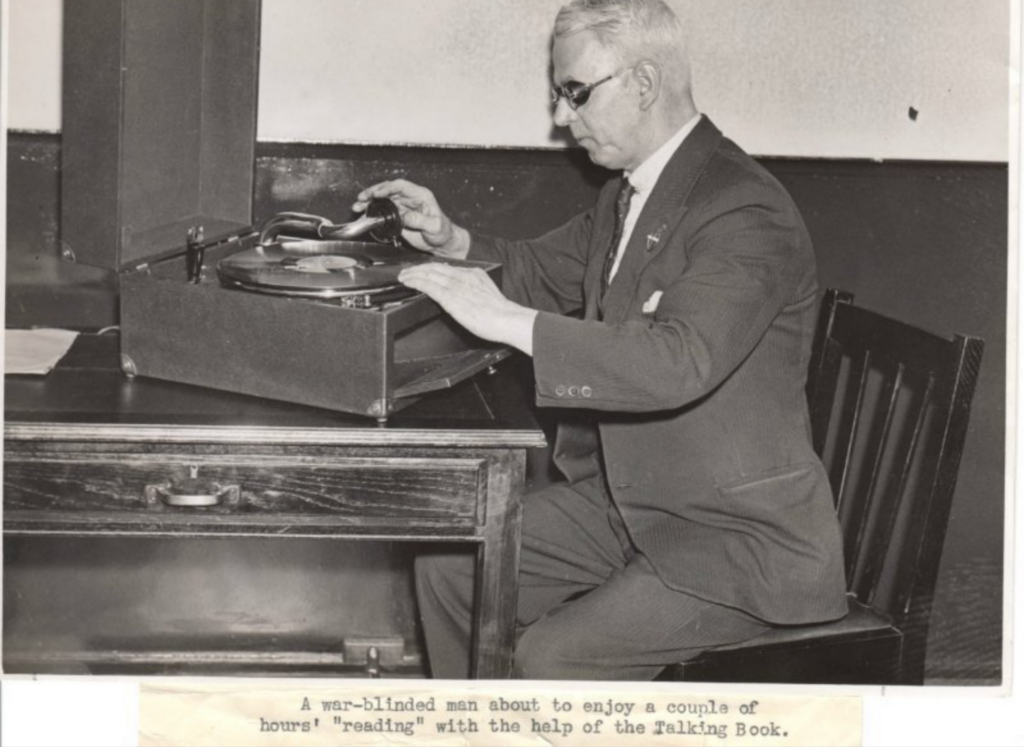
1935: RNIB Talking Books and WWI
In the UK, the history of recorded books for blind people begins with RNIB’s Talking Books service, which launched in 1935.
The service was developed initially in response to the needs of soldiers blinded during the First World War. Many of these men had been literate before their injuries and found the loss of access to books and reading material one of the most significant consequences of their blindness. The gramophone recording technology that had recently become widely available offered a solution.
What RNIB created was a postal library of recorded books that were sent out on gramophone records to registered members, returned when finished, and replaced with the next title on their list. The format changed continuously as technology evolved: wire recordings, vinyl, reel-to-reel tape, cassette, CD, DAISY digital audio, USB drives, and digital download. The purpose never changed.
RNIB Reading Services today holds tens of thousands of titles across genres, available to blind and partially sighted people in the UK. It remains one of the most comprehensive accessible reading libraries in the world, and it is one of the content sources included in RealSAM BookClub.
1959–1990: Organisations that have shaped accessible reading in the UK
RNIB’s Talking Books service is the most well-known, but it’s far from the only contribution to accessible reading in the UK. Many other organisations have taken different approaches to the same problem, each serving parts of the community that might otherwise have been missed.
Here are just a few of them…
Listening Books was founded in 1959 and extends audiobook access beyond the blind and visually impaired community to anyone whose illness or disability affects their ability to read print — including people with dyslexia, arthritis, mental health conditions, and other conditions that make holding or reading a book difficult. Their service is subscription-based and available by post and digitally.
Living Paintings, founded in 1989, produces Touch to See books: tactile picture books with audio guides, provided free of charge to blind and partially sighted children and adults. Their collection covers art, natural history, science, and picture books for children. The tactile pictures are made using specialist printing techniques and are designed to be explored by touch.
ClearVision has been running since 1990; A postal library that provides braille and print books for blind and partially sighted children and their sighted peers. Their collection includes dual-format books (with both print and braille on the same page) designed to allow sighted and blind children to read together.
Reading Sight is a coalition of UK organisations (including ASCEL, the British Library, Calibre Audio, ClearVision, Libraries Connected, and RNIB) that work together to improve the availability and accessibility of library services for visually impaired and print disabled people. They have sent accessibility resource packs to every library service in England, educating them on how they can best support the needs of their local visually impaired community.
1990–2026: From Talking Books to Voice-First Services
The most recent chapter in the history of accessible reading is the one we’re still writing. Digital technology and voice interfaces have changed what’s possible for accessible reading in ways that earlier generations could not have anticipated.
DAISY (the Digital Accessible Information System) was developed in the 1990s specifically for blind and print-disabled readers, offering structured audio that allowed listeners to navigate by chapter, section, or page rather than simply rewinding and fast-forwarding. DAISY players became standard equipment for many blind readers, and the format is still widely used.
Smart speakers introduced a new interface. The ability to say “play my audiobook” or “read me the news” without touching a device or screen opened up accessible listening to people who had never been comfortable with earlier technologies. For older adults experiencing age-related sight loss in particular, the smart speaker has been one of the most significant changes in accessible technology in decades.
The challenge that remained was fragmentation. RNIB’s library in one place, LibriVox classics somewhere else, newspapers behind a different subscription, podcasts on yet another platform. Knowing what was available and knowing how to access it required a level of digital navigation that not everyone could manage.
Today: How RealSAM BookClub Contributes to This Tradition
RealSAM BookClub is our contribution to this ongoing history of accessible reading.
Like the many amazing organisations that came before us, RealSAM BookClub was born because we noticed a gap in literary accessibility: that the fragmentation of accessible services was a roadblock to certain members of the visually impaired community. Instead of managing multiple subscriptions, BookClub brings together the RNIB Talking Books, LibriVox, and Torch Trust libraries, RNIB Newsagent, radio, and a curated selection of podcasts and magazines into one voice-first experience—now available on RealSAM Pocket, Alexa, iOS, Android, and the web.
Simply ask for what you want, and it plays. Cross-device continuity means you can start on one device and continue on another without losing your place. Easily switch between a book, newspaper, and magazine with a few words.
We didn’t build BookClub because the existing services were inadequate (In fact, we think they’re all incredible); we built it because the gap wasn’t in the quality of individual services; it was in the experience of navigating between them, and in the absence of the community element that makes reading more than a solitary activity.
Our online BookClub reading forum features a monthly pick and discussion platform, adding something that no library by itself provides: A community of people who have been listening to the same book, at the same time, in the same way, and want to talk about it.
Sharing has always been part of reading. BookClub tries to make it available to the blind and partially sighted community in the same way it’s available to everyone else.
Find out more
If you’re a blind or partially sighted person in the UK, or if you’re supporting someone who is, you can find out more about RealSAM BookClub and the membership plans available at realsam.co.uk/bookclub.
Find out more and join BookClub →